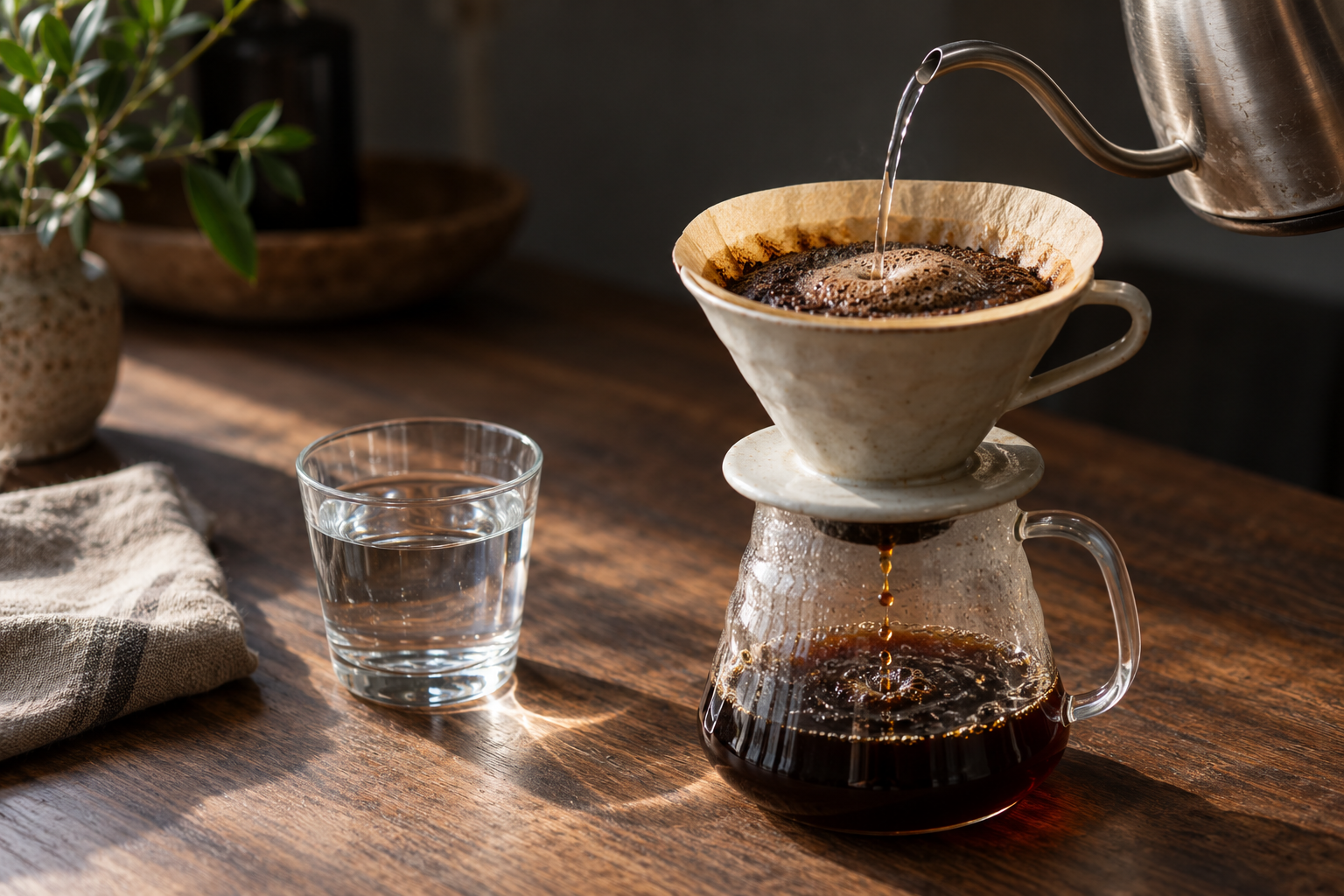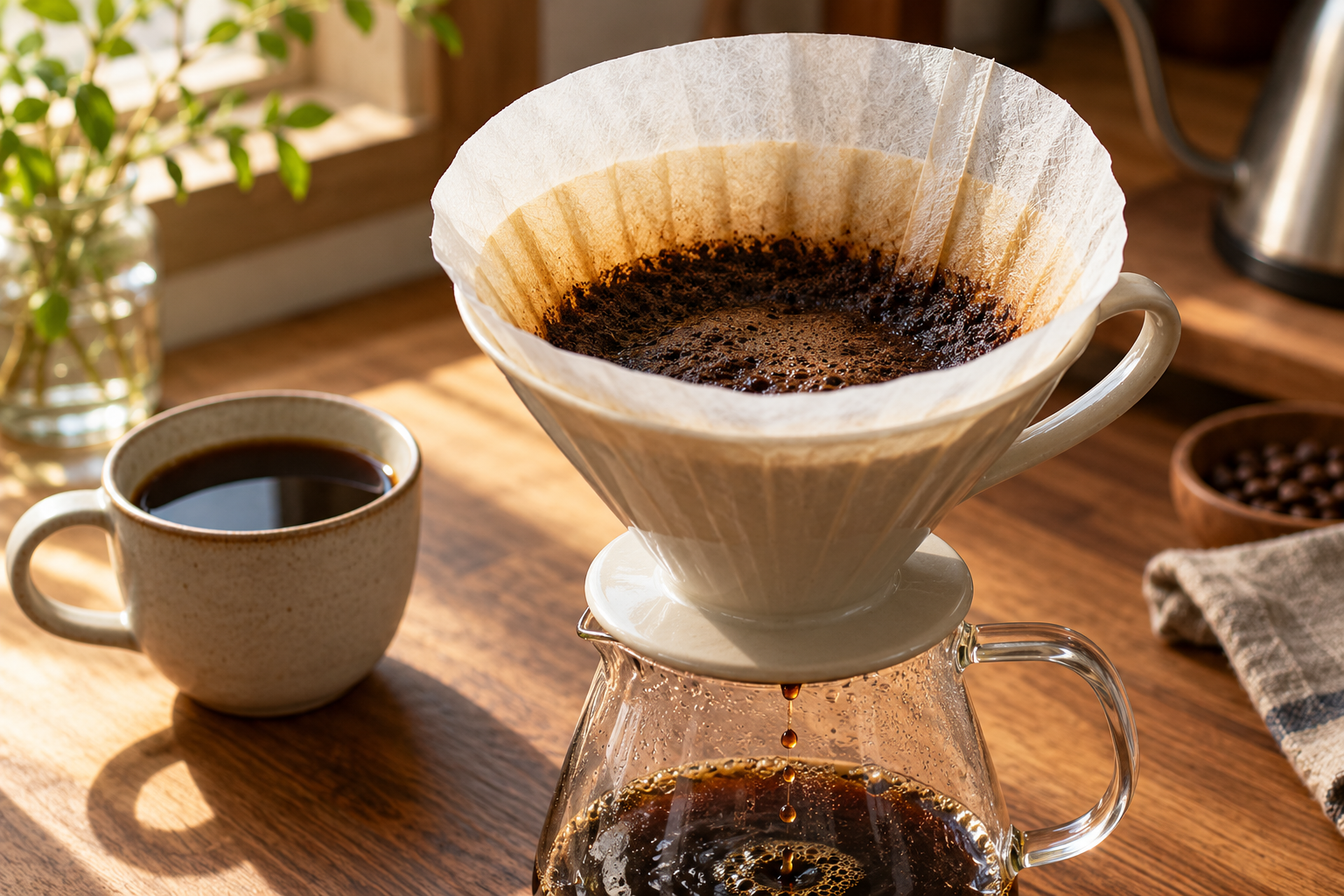
Lift a used paper filter from a dripper and look at what stays behind. There are the obvious grounds, but also a fine brown film against the pale fibres. The drink below is clear enough to see light through. Paper has changed the cup before anyone tastes it: it has decided which pieces of the brew can leave with the water.
That sounds like a simple sieve, yet a coffee filter is a fibrous, porous sheet working beneath a bed of particles. Water passes through both. Some material dissolves into the water; some remains as tiny suspended fragments or droplets. The paper can catch particles, and its resistance can change how long water stays with the grounds. It may even contribute a trace of its own flavour. Those are three different effects. Calling them all “the filter taste” hides the most interesting part.
What the paper actually holds back
The oil-derived coffee compounds cafestol and kahweol make a good test case because researchers can measure them. They are often used to draw a blunt line between “filtered” and “unfiltered” coffee. The actual route is more revealing. In a 2017 mass-balance experiment, Mery Rendón and colleagues measured where cafestol from their roasted coffee ended up after a paper-filter brew. Roughly 87% remained in the spent grounds, about 12% was associated with the paper, and less than 1% reached the drink. The paper mattered, but most of the starting cafestol had never left the coffee bed in the first place. Those percentages describe their coffee and preparation, not every bean or filter on the shelf.
The same group then compared papers of different construction. They measured cafestol and kahweol in brews made through filters of several sizes and origins, including papers with tiny manufactured perforations. Diterpene concentrations were higher through the microperforated paper than through comparable unperforated papers; finer coffee particles also raised the amount in that setup. Their paper tests showed that fat could pass through the material. The explanation they favoured was more specific than “paper absorbs the oils”: hot water releases relatively little of the coffee’s lipid fraction, while the paper holds back many of the finest particles that would carry more of it into the cup. A paper filter is therefore a particle barrier, not a watertight wall for every oil molecule.
More recent nuclear-magnetic-resonance measurements across eight brewing methods also found much lower cafestol and kahweol in paper-filtered drinks than in unfiltered ones. The authors suggested that suspended solids help carry the compounds. They compared complete methods—from V60 and Chemex to French press and Turkish-style brewing—so filter, grind, pressure, water contact and serving volume changed together. The work strengthens the case that filtration matters to what reaches the cup; it cannot assign every difference to paper alone.
There is a useful warning against treating any brewing label as a guarantee. In a Brazilian study using one medium-roasted Arabica coffee, paper-filtered and espresso samples had similarly low cafestol and kahweol per 50-millilitre serving, while cloth-filtered coffee had more of those compounds per gram of dissolved solids. Five separate brews were made for each method. That does not undo the larger pattern seen elsewhere; it shows how bean, dose, grind and method can alter the comparison. Paper generally reduces the passage of fine material in its own setup, but a named drink is not a fixed chemical recipe.
The sheet changes the route of water, too
A filter can alter a brew without chemically capturing a single aromatic molecule. Water has to find openings through the fibre network, and the paper sits against a dripper with its own ridges, walls and outlet. A measured example makes the point. In an original bench analysis of coffee filters, Jonathan Gagné used a switchable dripper to time room-temperature water through different pre-wet filters. With water alone, his tested papers flowed at different rates; his metal filter flowed much faster. He repeated each measurement six times and warned that grounds, clogging and viscosity could change the result. These figures are a comparison of those products in that apparatus, not a forecast of drawdown time for a coffee-filled dripper.
When grounds are present, fine particles can lodge at the paper and add resistance during the pour. Slower drainage can lengthen contact with water, though it does not automatically make the cup better: a long drawdown may also reflect a poorly flowing bed. The whole system matters. In a 2022 laboratory comparison of four pour-over arrangements, Chien-Li Chen and colleagues found differences in brew time, chlorogenic-acid measurements and volatile compounds among V60 paper, Kalita paper, flannel cloth and stainless-steel setups. The V60 and flannel arrangements ran faster; the Kalita arrangement ran longer and yielded the most chlorogenic acids in their comparison. Flannel and steel brews had higher total measured volatiles, which the authors suggested could reflect less absorption by those materials.
That last suggestion is plausible, but the study changed dripper and filter together. A Kalita’s shape and outlets are not a V60’s. Different flow can change the coffee before any adsorption by paper is considered. The result supports the modest conclusion that filter-and-dripper combinations can make chemically different cups. It does not prove that paper alone removes a fixed percentage of aroma, nor that more measured volatiles will smell better to every drinker.
Can the paper add flavour?
Sometimes the material itself belongs in the comparison. A 2019 study of beverage-filter materials used sensory tests and chemical instruments to compare extracts from a heat-sealed paper with an engineered synthetic non-woven filter. Under its test conditions, the paper extract registered more bitterness, and an odour-active compound associated with a cardboard note appeared in the material comparison. That is evidence that a filter can contribute flavour; it is not evidence that every clean paper filter makes every coffee taste of cardboard. The paper type, storage and test conditions matter.
If you suspect that effect, run hot water through an unused filter into a clean cup, then compare it with the same water that has not touched paper after both have cooled to the same temperature. A pre-rinse may help with a particular paper, and it also seats the sheet and warms the brewer. Taste the rinse water and discard it before brewing. There is no need to insist that every filter always needs rinsing when a simple comparison can answer the question for the one in your hand.
To separate filtration from extraction, you can make one immersion brew, stir and divide it promptly, then pass one portion through paper and the other through a clean metal sieve. Compare them at the same temperature and notice clarity, texture and flavour. The split will not be perfectly controlled—sediment, filtering time and cooling can still differ—but it holds the beans, water and main contact period far steadier than comparing a French press with a pour-over. To test flow instead, keep the dripper, coffee, grind and pour pattern fixed, change only the paper, and record drawdown over several brews.
The point is not to find the filter that removes the most. It is to notice what the filter is permitted to do. It holds back a fraction of the finest coffee material, allows dissolved substances through, and helps set the pace of the water. Sometimes its own fibres join the conversation. The cup changes because of all those small decisions at the boundary between grounds and glass.

A thought worth keeping?