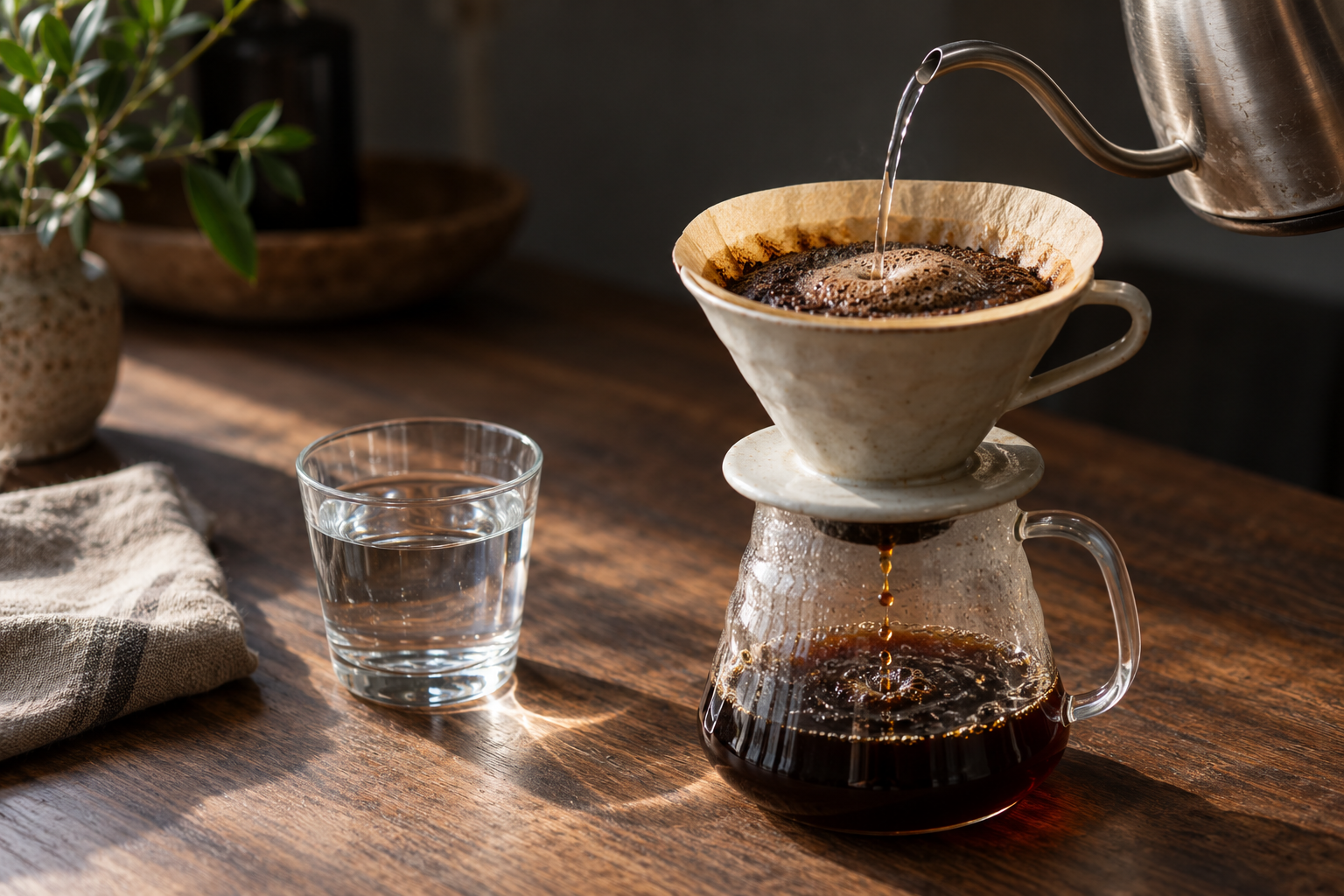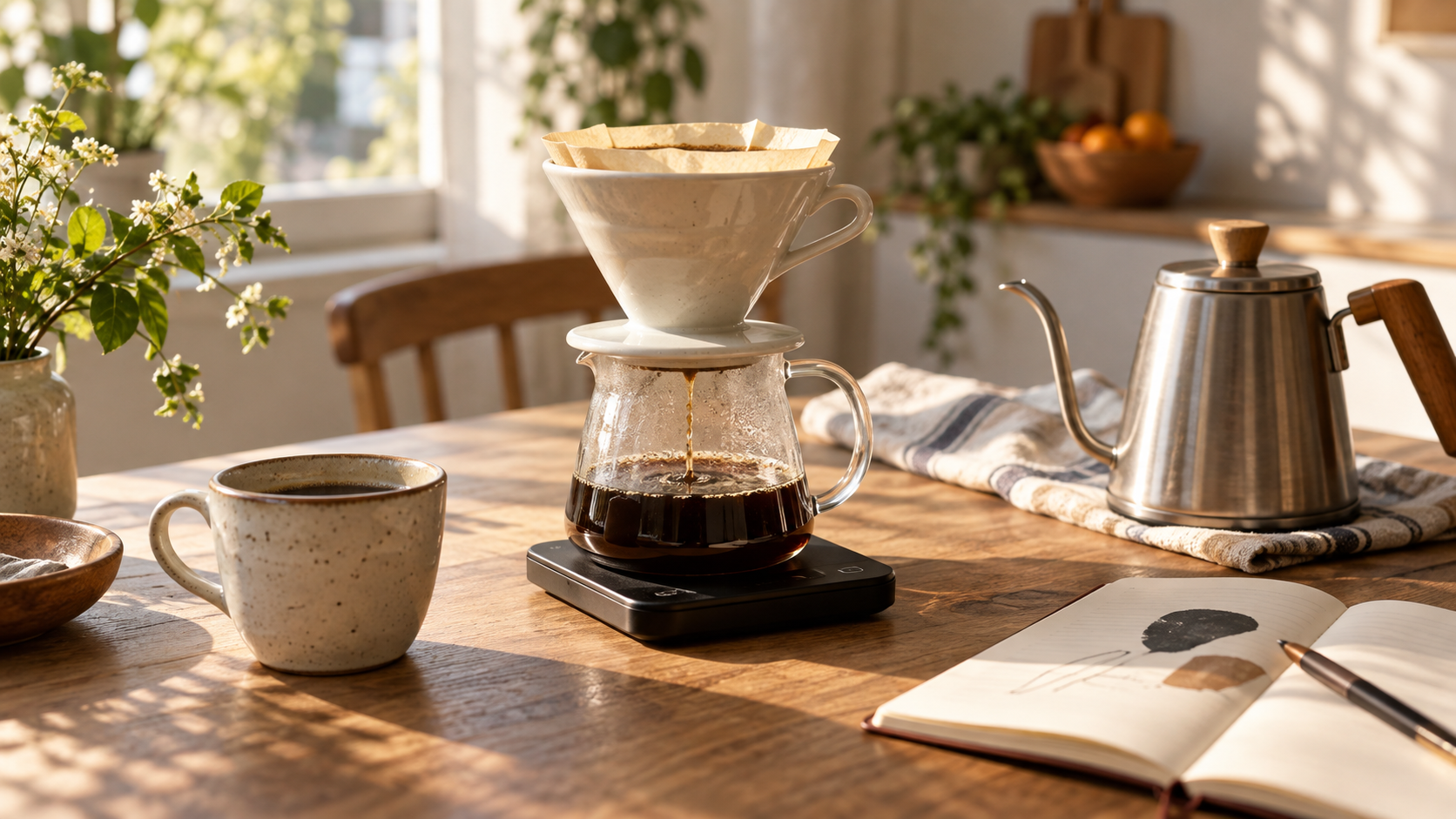
I had changed the coffee, the grind setting, the amount of water and the cup. The result tasted different. My notebook, displaying admirable restraint, declined to tell me why.
This was an experiment in the same way that reorganizing an entire room and then declaring one cushion responsible for the improvement is an experiment. Something had happened. I had made it unnecessarily difficult to understand what.
Home coffee can attract an impressive quantity of advice. Some of it is useful. Some of it turns a small morning drink into a permanent audition for technical seriousness. I was responding to every new possibility by adding another change, then wondering why the routine never became familiar.
Give one version a chance to exist
I chose a simple method from the guidance supplied with my brewer and made it recognizable. Same coffee, same basic quantities, same arrangement. I wrote the relevant details and a plain description of the cup. Pleasant, too sharp for my taste, fuller than yesterday, something I would happily drink again.
The tasting language did not need to impress anyone. Its job was to help me recognize my own preference on another morning. A notebook full of borrowed sophisticated words would be less useful if I could not connect them to an experience.
After repeating the starting method, I changed one detail and kept the rest as steady as practical. The result did not prove a universal rule about coffee. It gave me a comparison within my own kitchen and the conditions I had actually recorded.
There are limitations. A household routine is not a laboratory. Attention varies, equipment behaves as it behaves and a cup tasted while discussing tomorrow's work may receive a different review from one tasted quietly. I can acknowledge those limitations without abandoning every attempt to notice a pattern.
Decide whether the question matters to breakfast
Some questions are worth another comparison. Others mainly generate equipment browsing. Before pursuing a change, I ask what I hope it will improve. Can I describe the difficulty in the current cup? Would I recognize a useful answer? Am I trying to solve something I actually experience, or something I have recently been told to worry about?
That last question has been particularly helpful. A new discussion can manufacture dissatisfaction with a routine I enjoyed yesterday. Curiosity is welcome. An endless requirement to feel under-equipped is less welcome, especially before eating anything.
I keep the coffee corner simple enough to use when I am tired. The notebook is within reach. The usual objects have a home. A method that works only when I am in the mood for an elaborate ceremony will not describe most of my mornings.
I also give the enjoyable cup permission to remain enjoyable. There can be another experiment later. I do not need to revise the process continuously to prove that I am interested. Repetition lets me use what I learned.
Last week I repeated a cup I liked and made breakfast while it cooled a little. The entry in the notebook was short. Same arrangement, still pleased. I did not open a shopping page or invent an urgent new technical deficiency.
The routine had become more predictable because I had reduced the number of questions arriving simultaneously. There was still room for curiosity. There was finally enough room for drinking the coffee as well.

A thought worth keeping?